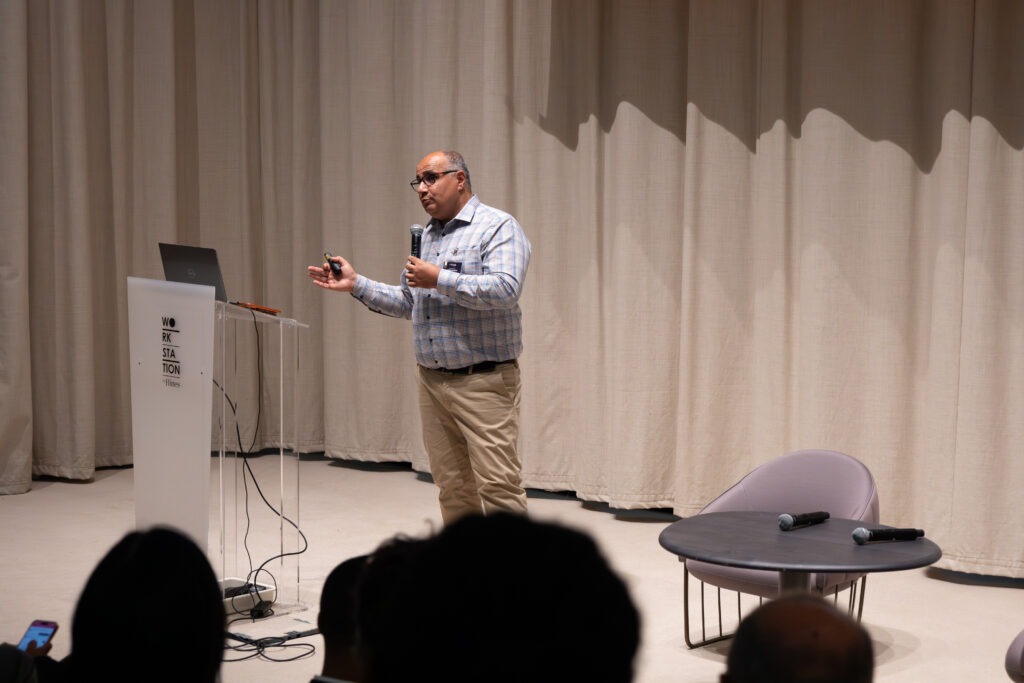

Interview with Lou de Gaetano, AI Product Owner at kShuttle
AI agents are now at the centre of many corporate strategies. They promise to automate tasks, improve decision-making and profoundly transform the way teams work.
And yet, one reality remains: most initiatives never make it beyond the pilot stage.
Why is there still such a gap between technological promise and real-world adoption?
“The problem is no longer the technology”
kShuttle: Companies are investing heavily in AI. Why do so many projects remain stuck at the pilot stage?
Lou de Gaetano: Because we still tend to look at the issue through a technical lens, when that is no longer where the main problem lies.
Today, the question is no longer whether AI works. The capabilities are there.
The real challenge is understanding the conditions under which teams actually accept working with these systems. And that is precisely where many projects get stuck.
“Adoption does not begin with trust”
kShuttle: Trust is often described as the main barrier. Is it really the starting point?
Lou de Gaetano: Not exactly.
We tend to assume that users do not adopt AI because they do not trust it. In reality, the dynamic is more subtle.
In the early stages, trust is not the direct trigger for adoption. It influences the way users perceive the value of the system. When an AI agent is understandable, consistent and controllable, it is more likely to be perceived as useful. And it is this perceived usefulness that drives adoption.
Trust, in turn, is built progressively through experience.
“Before trust, there is experience”
kShuttle: What actually happens during those first interactions?
Lou de Gaetano: Users do not think in abstract terms of trust. They ask themselves very practical questions.
They try to understand what the system is doing, whether its behaviour can be anticipated, whether it provides a real benefit in their work, and whether they still retain a sufficient level of control.
Before trust can emerge, the user experience comes first. And that experience shapes the entire adoption process.
“An impressive AI is not enough”
kShuttle: And yet, many demonstrations are convincing.
Lou de Gaetano: Yes, but a demonstration does not create usage.
There is a gap between what a system is capable of doing and the place it actually finds in people’s day-to-day work. An AI system can be highly effective and still never be used if it is not properly integrated, if it is not understood, or if it is perceived as risky.
The issue with AI agents is not that they do not work. It is that they struggle to find their place.
“Scaling changes the nature of the project”
kShuttle: Why does something that works in a pilot often fail when scaled?
Lou de Gaetano: Because a pilot takes place in a controlled environment. The use cases are well defined, the users are engaged, and the conditions are favourable.
When you scale, the situation changes completely. User profiles become more diverse, business constraints emerge, reliability requirements increase, and tolerance for error decreases. The question of accountability also becomes central.
At that point, it is no longer just about performance. It becomes a question of framework.
“Adoption is a cycle, not a moment”
kShuttle: What actually enables a project to move beyond that stage?
Lou de Gaetano: Adoption does not happen once and for all. It is a continuous process.
Users test the system, adjust their perception, reassess its usefulness and gradually build their level of trust. This cycle repeats and refines itself over time.
That dynamic determines whether an AI agent remains an occasional tool or becomes a lasting part of everyday work practices.
“Trust becomes organisational”
kShuttle: What role does the organisation play in this process?
Lou de Gaetano: A decisive one.
At a small scale, trust is individual. But for AI to be deployed at scale, trust must become organisational. That means making systems understandable, allowing users to remain in control, and embedding their use within a clear framework.
Without these elements, AI remains isolated in local use cases. With them, it can become durably embedded in collective practices.
“Useful, understandable and governable AI”
kShuttle: How does this vision translate concretely at kShuttle?
Lou de Gaetano: The goal is not to add AI for the sake of adding AI.
In a business platform such as ExRP, AI is designed as a component of the applications themselves, integrated into existing workflows and data environments. These are environments where users handle sensitive, regulatory, financial or ESG data.
In that context, AI must provide practical support: helping qualify data, assisting analysis, detecting inconsistencies or supporting reporting production. But it has to do so within a controlled framework.
In these environments, AI cannot be designed as a generic assistant. It must meet strong requirements in terms of traceability, control and auditability.
Ultimately, the challenge is not only to make AI powerful. It is to make it useful, understandable and governable.
“Usage does not come from the wow effect”
kShuttle: What really makes the difference when it comes to adoption?
Lou de Gaetano: In the world of business software, usage does not come from the wow effect. It comes from a concrete gain.
Time saved. An error avoided. A data point better qualified. A smoother process.
This is particularly true in the environments we address, such as regulatory reporting, finance, sustainability and tax.
In these fields, AI is not meant to impress. It must first secure, assist and accelerate — without making the process opaque.
“AI does not impose itself. It settles in.”
kShuttle: What do companies need to change today?
Lou de Gaetano: They need to stop treating adoption as an automatic consequence of technical performance.
AI does not impose itself because it is powerful. It settles in when it becomes obvious in users’ daily work. The companies that succeed will not necessarily be those running the most experiments, but those that create the conditions for real usage: visible usefulness, a smooth experience, a clear framework and accepted responsibility.
At the end of the day, unused AI has no value.
Conclusion
At kShuttle, this approach translates into AI integrated within the ExRP platform, designed for demanding business environments where data is sensitive, processes are structured and auditability requirements are high.
In this context, AI is not a disruption. It is an extension of existing applications, capable of providing concrete support while respecting business constraints.
This requires a shift in perspective. The goal is no longer only to design high-performing systems, but to embed them in a framework that enables real usage: connected to data, aligned with workflows and governed by clear rules.
That is what separates an experiment from a working tool.
Ultimately, AI projects do not remain stuck because they lack performance.
They remain stuck when they fail to become part of everyday practices.
And that is precisely where their transformation begins.
Discover ExRP
FAQ
Why do AI agents often remain stuck at the pilot stage?
AI agents often remain stuck at the pilot stage when they are not truly integrated into users’ workflows. Technical performance alone is not enough: adoption also depends on perceived usefulness, the usage framework, governance and organisational trust.
What is the main factor driving the adoption of an AI agent in business?
The main factor driving adoption is perceived usefulness. An AI agent is adopted when it delivers a concrete benefit in teams’ day-to-day work: time saved, errors avoided, better-qualified data or a smoother process.
Why does business AI need to be governable?
In regulatory, financial or ESG environments, AI cannot operate as a generic assistant. It needs to be traceable, controllable, understandable and integrated into existing processes in order to meet requirements for auditability and accountability.
| Lou de Gaetano is AI Product Owner at kShuttle, where she designs and deploys AI agents integrated into business processes. With a background in Data Science and AI Strategy, she developed expertise in AI systems engineering before moving towards product and adoption challenges. Her work focuses on how AI systems operate and how they can be meaningfully embedded into real business use cases. |