
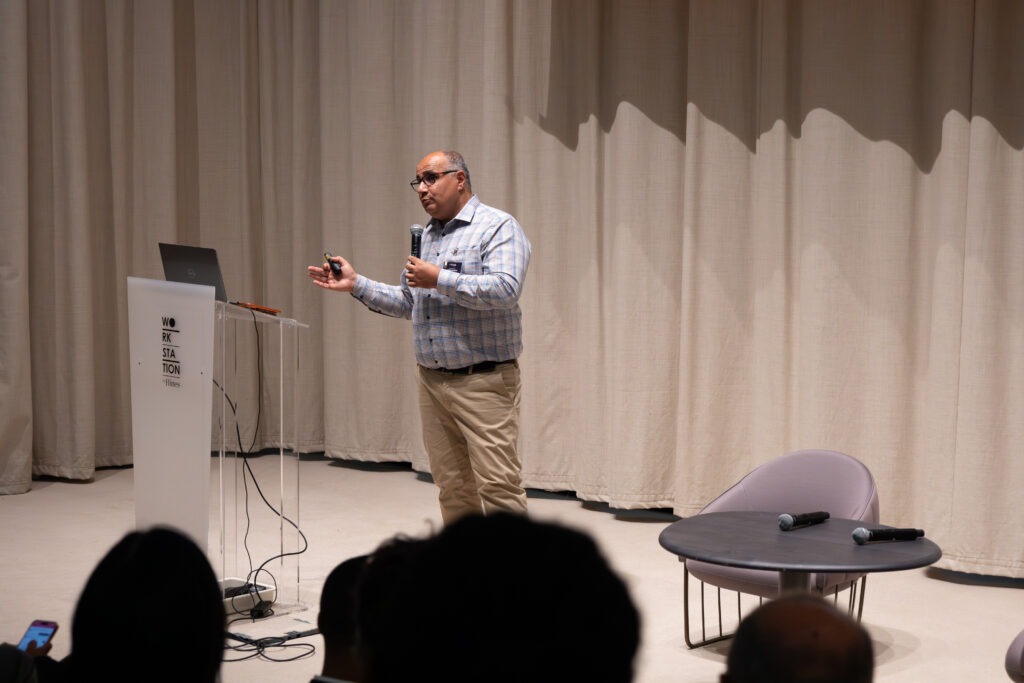
During kShuttle Connect | Grand Format, Ména Dogan looked back on the evolution of kShuttle, the development of the ExRP platform, the rise of regulatory complexity, data sovereignty and the role of artificial intelligence in enterprise software.
For more than a decade, kShuttle has evolved around the same operational problem: companies produce more and more critical data, but still too often manage it through fragmented systems.
Financial reporting, international tax, ESG, CSRD, Pillar Two, IFRS 16, documentation, controls, auditability: regulations do not only accumulate in legal texts. They also accumulate inside organisations, tools, spreadsheets, processes and responsibilities.
This shift was at the heart of Ména Dogan’s intervention during kShuttle Connect | Special Edition.
The purpose was not only to tell the story of kShuttle. It was to explain why companies now need a different kind of platform: not one more tool, but a foundation capable of connecting data, business teams, rules and decisions.
kShuttle was born from a very pragmatic approach
Q: During kShuttle Connect, you looked back on more than ten years of company evolution. How was kShuttle created?
Ména Dogan : kShuttle was born from a very pragmatic approach.
At the beginning, our objective was not to build a “complete platform” or to define a grand technology model. We wanted to solve concrete problems faced by companies.
Many of our clients already had information systems in place, but these systems were fragmented. They existed, but they did not communicate well with one another. They stored data, but did not always allow organisations to use that data across departments or processes.
We therefore started by developing APIs to connect existing systems. The idea was not to replace the entire architecture, but to enrich it, make it communicate and create continuity where organisations were still facing breaks in the data chain.
Over time, a broader reality became clear.
Some companies had systems, but these systems were too siloed. Others had no real system for certain critical processes, only Excel files. Some needs could be addressed by enhancing an existing tool. Others required building a complete business application from the ground up.
This is how kShuttle’s DNA was built: connect when connection is needed, build when building is necessary, and always start from the real business need.
Regulation has become a governance issue
Q: The shift from custom applications to regulatory and compliance software was a major turning point. What drove that change?
Ména Dogan : Around 2016–2017, we identified a major shift: regulation was no longer only a matter of compliance.
It was becoming a governance issue.
Companies no longer had to simply produce a report at a given point in time. They had to collect data, control it, document assumptions, justify results, retain evidence, involve multiple departments and respond to regulatory frameworks that keep evolving.
This is true for financial reporting. It is true for tax. It is true for ESG, CSRD, the EU Taxonomy, Pillar Two and IFRS 16.
These topics follow different rules, but they share a common structure: large data volumes, complex rules, demanding deadlines, multi-stakeholder processes and a strong need for traceability.
We understood that a new market was emerging.
This market did not only need traditional reporting tools. It needed applications capable of supporting complete regulatory processes, with data, controls, workflows, validations, auditability and the ability to evolve over time.
This conviction led us to invest in software specifically designed for regulatory environments.
Compliance can no longer be treated as a layer added at the end of a process. It must be embedded in the way data is structured, controlled and used.
The problem is not the lack of tools. It is fragmentation.
Q: You often insist on the concept of a platform. How does kShuttle’s approach differ from traditional enterprise software?
Ména Dogan : Traditional enterprise software often follows a simple logic: one need, one tool.
But companies do not operate like that in reality. Their challenges are deeply interconnected.
Performance management is connected to finance. Tax depends on consolidation data. ESG relies on operational, financial and sometimes HR information. Compliance requires rules, controls, supporting evidence and decisions to be documented. Auditors need to understand where the data comes from, how it has been transformed and why a specific result has been produced.
When each topic is handled through a separate system, the company does not reduce complexity. It moves it somewhere else.
kShuttle’s platform approach is based on a different idea: organisations need a common foundation to manage different processes that share the same requirements for reliability, traceability and control.
This foundation is based on three principles.
First, a unified data model. Data should not be copied, reprocessed and reinterpreted at every stage.
Second, smooth collaboration between applications. A platform should allow different regulatory and business topics to operate within the same environment, without recreating silos.
Third, business users must remain in control. Finance, tax, sustainability, reporting and compliance teams need to manage their processes without depending entirely on IT for every adjustment.
For us, this is what a platform is: an environment that connects data, rules, processes and decisions.
Data sovereignty cannot be a surface-level argument
Q: Data security and sovereignty have become major issues in regulatory environments. How does kShuttle address them?
Ména Dogan : There can be no compromise on these topics.
Saying that data is hosted in France is not enough. Organisations also need to look at the applicable legal frameworks, technology dependencies, security mechanisms, access rights, traceability and the ability to prove what has been done in the system.
Data sovereignty should not be a marketing argument. It should be an architecture.
From the design stage, we have worked to ensure consistency between data hosting, legal frameworks and security requirements. In regulatory environments, this is essential because the data being processed is sensitive: financial data, tax data, ESG data, entity data, reporting data, assumptions, adjustments and supporting evidence.
We also embed controls directly into the applications: validation rules, XML controls, workflows, historisation and audit trails.
In some reporting processes, more than 250 control rules can be embedded directly into the system.
This point is important: compliance should not be a correction applied after the fact. It should be a structural capability of the system.
Artificial intelligence does not replace judgement
Q: Artificial intelligence is transforming enterprise software. What role does AI play at kShuttle in regulatory and management environments?
Ména Dogan : AI should not be presented as a magic button.
In regulatory environments, that would even be dangerous. We need to distinguish between tasks that are deterministic and tasks that require interpretation, context or judgement.
At kShuttle, our principle is clear: what can be automated through system rules should be automated. What requires interpretation, analysis or judgement can be supported by AI, but the final decision must remain human.
In practice, AI can help interpret complex regulatory texts, generate explanations, produce summaries, identify relationships within multidimensional data or support users in understanding a process.
But AI should not become a black box.
In fields such as finance, tax, ESG and compliance, companies must be able to understand why a recommendation is made, which data it is based on and what its limitations are.
AI is an amplifier of intelligence. It is not a substitute for judgement.
Reducing the cost of complexity
Q: How would you summarise kShuttle’s long-term vision?
Ména Dogan : Our ambition is not to accumulate features.
Our ambition is to reduce the cost of complexity for companies.
Regulations are multiplying. Data volumes are increasing. Organisations are becoming more international, more cross-functional and more exposed. Teams must respond to changing requirements while producing data that is reliable, auditable and useful for decision-making.
In this context, companies do not need more isolated tools.
They need a platform capable of bringing this complexity together, structuring it and making it manageable.
This is where kShuttle continues to invest: building a foundation that connects regulatory, financial, tax, ESG and business data, while giving teams the ability to understand, control and decide.
The real question is no longer only: “Do we have a tool to answer this obligation?”
The real question becomes: “Do we have a platform capable of controlling complexity over time?”
Key takeaways
The story of kShuttle reflects a broader transformation in enterprise software.
For years, organisations looked for tools to address isolated needs. Today, they must manage interconnected systems of constraints: finance, tax, ESG, reporting, compliance, audit, security, sovereignty and artificial intelligence.
The answer can no longer be a stack of disconnected applications.
It requires a common foundation capable of structuring data, circulating rules, documenting decisions and turning compliance into a management capability.
This is the role ExRP© is designed to play: not adding another layer of complexity, but making complexity controllable.
FAQ
ExRP is the platform developed by kShuttle to structure, secure and manage regulatory, financial, tax, ESG and business data. It connects data, processes, rules and applications within a common environment.
Companies need a regulatory platform because financial, tax and ESG reporting obligations rely on increasingly large, complex and cross-functional data sets. A platform helps reduce silos, secure workflows, document controls and strengthen auditability.
Business software usually addresses a specific need. A platform connects several needs, applications and departments through a shared foundation of data, rules, security and workflows. In regulatory environments, this approach is essential to avoid tool fragmentation.
Data sovereignty matters because regulatory software handles sensitive information, including financial data, tax data, ESG data, supporting evidence, controls, assumptions and decisions. Sovereignty is not only about hosting. It also involves legal frameworks, access rights, security and traceability.
AI can help teams interpret complex texts, generate summaries, explain results or identify relationships within multidimensional data. However, in regulatory environments, AI must remain controlled: deterministic tasks should be automated through system rules, and final decisions must remain human.
kShuttle’s long-term vision is to reduce the cost of complexity for companies. As regulations, data volumes and auditability requirements increase, kShuttle develops ExRP as a foundation that connects compliance, data, processes and decision-making.